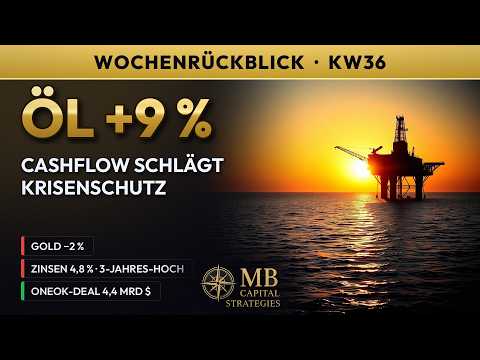
In short: Week 36 showed a clear rotation — energy +3.9% vs gold -2.1%. At 4.8% US 10-year yields (highest since Nov 2023), the market rewards assets that produce cashflow over those that merely store value. Brent closed at $96.28 (+9%), eight shipping stocks hit new highs, and three billion-dollar energy deals closed. Not investment advice.
Published: September 7, 2026 | Author: Marco Bozem | Sources: FMP end-of-day data (03.09.2026), Parqet portfolio feed, MBFinanceMate dashboard
Disclosure: I hold positions in the publicly accessible portfolio (Trade Republic / Scalable). No investment advice.
Brent crude closed at $96.28 — up roughly 9% for the week — driven by US strikes on Iranian positions and tensions in the Strait of Hormuz. WTI jumped above $86. Gold gave ground to around $4,435 (Wednesday close), down 2.1%. The VIX sits at 15.2, up 5% week-over-week but nowhere near panic territory.
The S&P barely moved (+0.1%); the DAX lost 2.7% as European industrials lagged. Meanwhile US crude oil inventories are running 17.5% below their five-year average — supply is tight when geopolitical risk spikes.
| Metric | Close | WoW Change |
|---|---|---|
| Brent Crude | $96.28 | +9% |
| Gold | ~$4,435 | -2.1% |
| VIX | 15.2 | +5.3% |
| S&P 500 | — | +0.1% |
| DAX | 25,852 | -2.7% |
| US 10Y Yield | 4.79% | highest since Nov 2023 |
The story here is reflation: growth is expanding, inflation sits at 3.3% (above target), and in this environment hard assets with cashflow get tailwinds — commodities, energy, shipping.
This isn't about gold being "wrong" long-term. It's about opportunity cost. When the risk-free rate sits near 4.8%, every asset has to justify itself against a Treasury bond that actually pays. A gold bar produces zero cashflow. An oil producer or tanker company does.
The fear-and-greed index at 42 (neutral, slightly fearful) confirms this isn't a flight-to-safety trade — it's a rotation into yield. REITs show the flip side: Realty Income paid its 674th consecutive monthly dividend at a 5.27% yield, but against a 4.79% risk-free rate, the spread is too thin to drive momentum.
The shipping data tells the starkest story. Torm reported a record quarter — Hormuz disruptions are pushing product tanker rates higher, and the stock sits at its 52-week high of $35.35. Dorian LPG is at an all-time high of $52.11 despite ordering three new dual-fuel LNG carriers from Hanwha Ocean (~$345M, delivery 2030) — the market sees rate strength that outpaces supply additions.
The contrast within the same segment proves it's execution-driven, not just sector beta: BW LPG reported weak quarterly numbers, cited operational headwinds, and placed a $300M convertible bond. The stock fell 2.1%. Same industry, different execution.
Eight shipping names hit new highs this week: Torm, Dorian LPG, International Seaways ($102.37), DHT ($20.63), Genco, Star Bulk ($31.82), Global Ship Lease ($45.49), and Nordic American Tankers ($7.20). The chokepoint assessment for tankers remains extremely bullish — Hormuz and the Red Sea under simultaneous pressure, detours around capes binding tonnage.
The deal flow confirms where capital is moving:
Three major deals, all upstream or midstream energy. No tech buyouts, no consumer consolidation — capital is flowing into the same cashflow engine that's driving stock performance.
Next week carries two heavyweights: the ECB rate decision and US inflation data (CPI/PCE). The Fed funds rate sits around 3.6% with a slightly positive yield curve at 0.4%. High-yield spreads at 265 basis points show no credit stress.
If inflation holds above target while growth stays firm, the reflation trade deepens — and assets that produce cashflow rather than store value will continue to outperform.
Related Analyses
Tanker Dividend Safety 2026 — FCF coverage deep dive.
Best Tanker Stocks 2026 — Which tankers actually pay?
Hard Asset Market Check September 2026 — Macro backdrop.
Further reading: Oil & Gas Stocks Overview
Further Analysis: