The Trigger: Two Burning Tankers and a Monday Deadline
In the early hours of August 14, 2026, two tankers owned by the UAE's state oil company ADNOC were attacked in the Strait of Hormuz. No one was injured; the UAE condemned the attack, blamed Iran, and called it a violation of UN Security Council Resolution 2817.
At the same time, the 60-day ceasefire between the United States and Iran expires this coming Monday, August 17 — 60 days after the MOU was signed June 17. The strait remains de facto blocked, though Iran and Oman are reportedly close to a shipping-corridor deal, details to follow over a further 60-day window. Brent has gained roughly three dollars since Monday. What happens after the deadline, nobody can honestly tell you — but the date is a fact, and it's why the other two numbers in this week's headline exist.
Macro Dashboard: Eight Signals, Two Directions
Caveat: Friday's US session was still open or just closed at data-pull time, so windows below end Wed/Thu instead of Fri — noted at each figure.
S&P 500
7,798.99
+0.53% (Thu close)
Nasdaq Composite
26,803.03
+0.42% (Thu close)
VIX
14.63
-1.8% (single-source)
DAX
26,440.31
+0.78% (Fri close)
Brent Crude
$87-93
+6.4% spot (Tue window)
Gold
~$4,351
roughly flat on the week
US 10Y Yield
4.68%
+3bp (Wed window)
Baltic Dry (BDI)
2,844
-7.93% (Thu)
Note: Brent quotes ranged from $87-88 on futures screens to $93.26 on the EIA spot series — likely spot-vs-futures divergence rather than a data error; both agree on direction. Capesize daily earnings fell 12.9% to ~$40,500/day. WTI gained 6.3% to $84.77 (Tue window). Gold and the Dollar Index carry no percentage this week — sourced figures disagreed too much to trust either number. Source: FRED (SP500, NASDAQCOM, VIXCLS, DGS10, DCOILBRENTEU, DCOILWTICO), Baltic Exchange, cross-checked against Reuters/Yahoo Finance/dpa.
Three Soft US Prints in a Row — and Barely a Ripple
July producer prices, released Thursday, came in unchanged against consensus of +0.1% and June's -0.1% — the third soft data point in a row, after the August 7 jobs report and August 12 CPI. Markets rallied on the print (S&P +0.7%, Nasdaq +0.8% that day), but the entire week added up to just +0.5%, versus +3.4% the week before on a single soft print. On Friday, preliminary University of Michigan consumer sentiment came in weaker and US indices dipped into the close.
Why the 10-Year Yield Rose Anyway
The 10-year yield climbed to 4.68% — up 3 basis points in a week of soft inflation data, which shouldn't happen together. My working thesis: the oil price. A blockaded strait pushing crude up several dollars reads as an inflation risk to bond markets, offsetting what a soft PPI print would otherwise do to yields. Counter-argument: three basis points is close to noise, and this series only runs through Wednesday. Plausible narrative, not proof.
Oil vs. Dry Bulk: Two Commodities, Opposite Directions
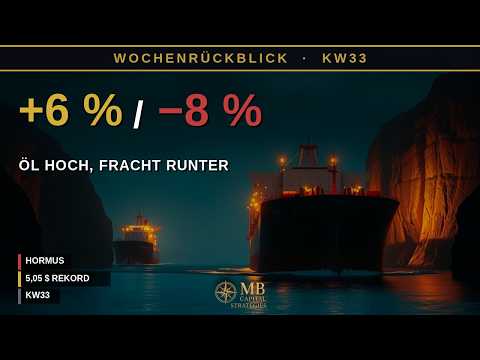
Brent gained roughly 6%. Dry bulk freight rates (Baltic Dry Index) fell nearly 8%. Capesize daily earnings dropped almost 13%. Three commodity segments, three directions, the same five trading days — a near-exact mirror image of KW32, when metals and mining led a 17-point spread over energy. The vane has swung: energy is up, and the segment that carried the rally two weeks running — dry bulk shipping — is losing eight percent. (Our usual 11-sector rotation chart doesn't run this week — the underlying data feed was down, and we'd rather skip it than estimate.)
Company News: Chokepoints, Vetoes and a Broken Vessel Deal
- ZIM / Hapag-Lloyd: Israel is moving toward blocking the $4.2bn ZIM sale via its "Golden Share" veto; the eight-ministry vote slipped to Sep 9, majority expected against. ZIM fell 2.6% on the report. Note: Hapag-Lloyd is the buyer — a collapsed deal isn't bad news for it.
- Diana Shipping / Star Bulk: Mutually terminated their March deal for 16 Genco vessels at Star Bulk's request. Diana's own Genco offer stands: $24.80/share (dividend-adjusted) plus one Diana share, $1.4bn financing unaffected.
- Wallenius Wilhelmsen: Revenue up, profit down on Middle East-driven bunker costs. Guidance was confirmed, not "raised" — it was already cut in Q1. H1 dividend: $0.61/share plus a $100 million special dividend.
- Rio Tinto / Tomago: ~A$3.6bn secures Australia's largest aluminum smelter through 2038, 100% renewable from 2033 — energy costs, not ore grades, now decide where smelters survive.
- Western Gateway Pipeline: Phillips 66, Kinder Morgan and HF Sinclair took final investment decision on a ~1,300-mile, ~$5bn line. Cash flow starts 2029 — a 2029 line, not a next-quarter one.
- Realty Income: Upsized a convertible note to $875m, bought back ~3m shares, entered a $6bn data-center joint venture — trading predictability for growth.
- Sherritt / Blue Owl / Cosan: A Glencore-backed group bid C$0.12/share for distressed miner Sherritt. Blue Owl priced a $750m note at 6.75% — a gauge of the price of money. Cosan's loss narrowed Friday (figures reserved for premium coverage per our earnings-detail policy).
- Port Hedland (BHP): The world's largest bulk terminal saw its first protected strike in 25+ years. BHP calls ~16 delayed cargoes minimal against 571.6m tonnes shipped through June — the union is negotiating against record profits and rising living costs.
Dividends: Four Companies, One Rate Environment, Four Different Answers
Four companies, the same rate backdrop, four different answers. International Seaways declared $5.05/share, the largest dividend in its history, payable September; trailing 12-month dividends total $12.61/share — a 21% yield by the company's own math. Wallenius Wilhelmsen paid out half its net profit ($0.61/share) plus a $100m special dividend. Realty Income raised its outlook while borrowing $875 million.
The fourth answer isn't from this week, but it's a useful counterweight: Flowers Foods cut its dividend in half earlier in 2026, to $0.125/share, to save ~$100m/year against ~$1.8bn in net debt — ending a 24-year streak of increases. That streak didn't protect it once free cash flow stopped covering the payout. The common thread across all four names is cash flow, not sector.
My Take
Three soft US data points moved markets less, combined, than a single one did the week before — this rally happened because nothing bad occurred, not because anything good did. What actually drove the week came out of a strait, not Washington: the Gulf conflict shows up simultaneously in the oil price, the 10-year yield, and a Norwegian car carrier's margin.
Stated as a thesis: whoever is collecting these tanker dividends is collecting a risk premium, not a quality premium — it's this high because the situation is uncertain. If Monday resolves calmly, part of it disappears; that's not a reason to sell, just a reason not to mistake it for a permanent yield. And the oil-vs-bulk lesson repeats: treating "shipping" or "commodities" as one trade means measuring two markets with one thermometer. This week they pointed opposite ways; seven days earlier, it was the reverse.
KW34 Outlook (Aug 17-21, 2026)
KW34 Calendar
- Mon Aug 17 — the Hormuz ceasefire deadline itself, the highest-impact date on the calendar; anything beyond the date is speculation.
- Mon Aug 17 — Thungela Resources H1 2026 results (12:00 SAST). Direction is known from last week's trading statement; the open question is how much of the profit jump is cash versus a one-off disposal gain.
- Tue Aug 18 — BHP full-year results, alongside the ongoing Port Hedland dispute.
- Tue Sep 9 (further out) — Israel's eight government bodies vote on the ZIM/Hapag-Lloyd sale.
A full calendar scan across the wider portfolio wasn't possible this week (same data-feed outage as the sector chart) — the three dates above were checked by hand against two sources each; roughly two dozen other positions remain unchecked.
Not financial advice. All information is for educational and informational purposes only. Act on your own judgment. Disclosure: My publicly viewable portfolio (Trade Republic + Scalable Capital, via Parqet) is spread across 231 individual positions. Of the companies named in this article, I hold International Seaways, Cosan, Thungela Resources, ZIM, Hapag-Lloyd, Diana Shipping, Star Bulk Carriers, Genco Shipping & Trading, Rio Tinto, Kinder Morgan, Phillips 66, Realty Income, Glencore, Blue Owl Capital, BHP, Wallenius Wilhelmsen and Flowers Foods — mostly as small positions. HF Sinclair and Sherritt International, also named in this article, are not part of my portfolio. That doesn't change the facts above — but you should know where I stand. This is transparency, not a recommendation. Price data as of Aug 13/14, 2026, two-source verified throughout.
Go deeper: Shipping Stocks Hub 2026 (this week's mirror-image sector) · Mining Stocks Hub 2026 · REIT Investing 2026 · Maritime Chokepoints Explained
For fundamental data I use InvestingPro* — the dividend-coverage and cash-flow charts are what I pulled to cross-check International Seaways' payout ratio and Wallenius Wilhelmsen's guidance history this week. My link gives you an extra 15% off on top of any active promotion. *Affiliate link — no extra cost to you.
📊 Want to see why I use it daily? Read my InvestingPro Review + Best Price for the full breakdown.